Contact Us Today
Uncategorized
Roof Financing in Virginia: How to Pay for a Replacement When You’re Not Ready to Pay Cash
November 6, 2026

Why Roof Financing Is a Conversation Worth Having
A roof is not a discretionary purchase. When it needs to be replaced, the timeline is set by the condition of the roof, not by the homeowner’s bank account.
That reality puts a lot of Virginia homeowners in an uncomfortable position. They know the roof is failing. They know waiting makes it worse. But $10,000 to $15,000 in cash is simply not available right now, and the idea of putting that on a credit card feels reckless.
The good news is that the range of real financing options available to Virginia homeowners is wider than most people realize. The bad news is that not all of those options are equally good, and some financing offers that look attractive at first glance cost significantly more over time than a less flashy but better-structured loan.
This post walks through every major financing path, what it actually costs, and how to evaluate which one fits your specific situation.
Start Here: Does Insurance Cover It?
Before exploring any financing option, every Virginia homeowner should answer one question: was the roof damage caused by a covered event?
Standard homeowner’s insurance policies cover roof damage caused by wind, hail, falling trees, fire, and certain other sudden events. They do not cover damage caused by age, neglect, or gradual wear. But many homeowners assume their damage is age-related without ever having it evaluated by a professional, and some roofs that appear to have failed due to age have underlying storm damage that qualifies for a claim.
What to do before ruling out insurance:
- Contact your insurance provider and ask specifically whether roof damage from weather events is covered under your current policy
- Request a roof inspection from a qualified roofing contractor who can document storm-related damage indicators: granule loss patterns consistent with hail impact, cracked or displaced shingles from wind, fascia or flashing damage from debris
- File the claim if the damage qualifies, even if you are not certain it will be approved
Four Seasons Roofing provides insurance claim assistance as a direct service to Central Virginia homeowners. The team documents damage, works with insurance adjusters, and helps homeowners navigate the claims process — because getting the coverage you have paid for is not taking advantage of anything. It is using the system correctly.
If your claim is approved, your out-of-pocket cost may be limited to your deductible. That changes the financing conversation entirely.
Option 1: Contractor Financing Programs
Many roofing contractors, including those serving Central Virginia, offer financing programs through third-party lenders. These programs are designed to make the purchase decision easier by presenting monthly payment options at the point of sale.
How they work: The contractor has a relationship with a lending partner. You apply at the time of the estimate, often through a simple online process. If approved, you receive a credit line or installment loan to cover the roofing project, and you begin making payments to the lender after the work is complete.
What to look for:
- Promotional interest rates. Some contractor financing programs offer 0% or low-interest promotional periods, typically 12 to 24 months. If you can pay off the balance during the promotional window, this can be a genuinely cost-effective option.
- Deferred interest vs. true 0%. Read the fine print carefully. Some promotional offers are “deferred interest” programs, not true 0% loans. With deferred interest, if you do not pay the full balance by the end of the promotional period, all of the accrued interest — at the full rate, retroactively applied to the original balance — gets added to what you owe. The difference between deferred interest and true 0% can cost hundreds of dollars.
- Post-promotional rates. If you carry a balance past the promotional period, what is the standard interest rate? Rates of 25% or higher are common with contractor financing credit products.
Best for: Homeowners with good credit who can realistically pay off the balance within the promotional window, or who are comfortable with the ongoing payment terms if they cannot.
Option 2: Home Equity Loan
A home equity loan lets you borrow against the equity you have built in your home. It functions like a second mortgage: you receive a lump sum and repay it in fixed monthly installments at a fixed interest rate over a set term.
How it works: The lender calculates your available equity based on your home’s current appraised value minus your remaining mortgage balance. Most lenders allow you to borrow up to 80 to 85 percent of your total equity.
The advantages:
- Fixed interest rate means predictable monthly payments for the life of the loan
- Interest rates are typically lower than unsecured personal loans or credit cards because the loan is secured by your home
- Interest may be tax-deductible if the funds are used for home improvements (consult a tax advisor for your specific situation)
- Loan terms of 5 to 15 years allow for manageable monthly payments on larger project costs
The considerations:
- Your home is the collateral. If you default on the loan, you risk foreclosure. This is a serious commitment.
- There are closing costs, typically 2 to 5 percent of the loan amount, which add to the total cost of financing
- The application and approval process takes longer than a contractor financing program, typically 2 to 6 weeks
Best for: Homeowners with significant equity, good credit, and a preference for stable, predictable payments at competitive interest rates.
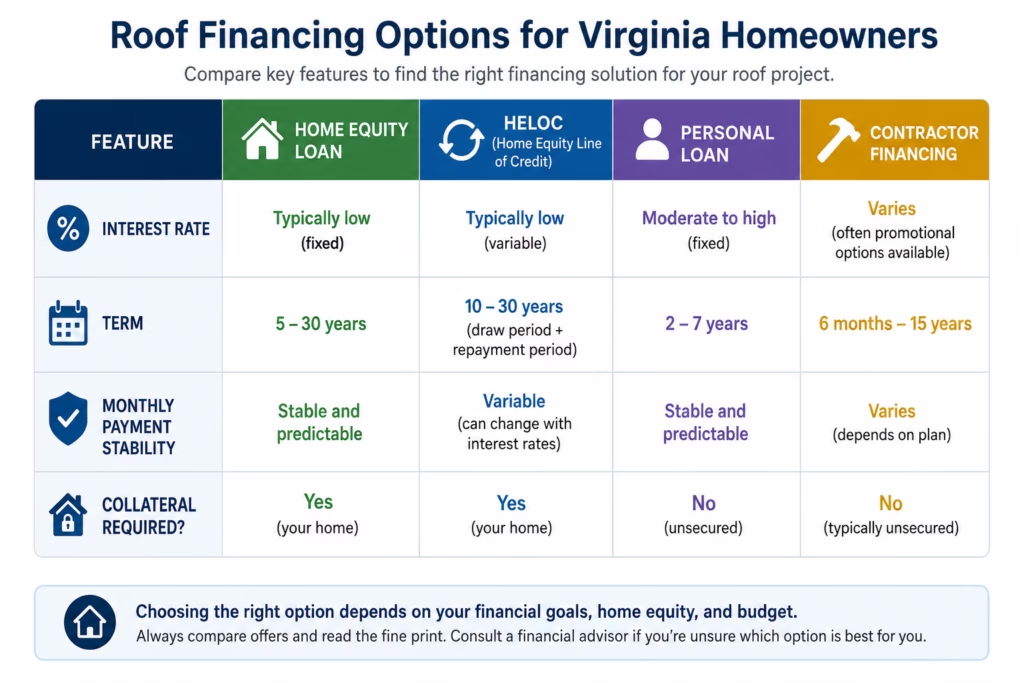
Option 3: Home Equity Line of Credit (HELOC)
A HELOC is similar to a home equity loan in that it uses your home equity as collateral, but it functions more like a credit card than a lump-sum loan. You are approved for a credit line up to a maximum amount and draw from it as needed during a draw period, typically 5 to 10 years.
How it works: During the draw period, you pay interest only on the amount you have actually used, not on the full credit line. After the draw period ends, you enter a repayment period during which you pay down the principal and interest.
The advantages:
- Flexibility: you only borrow what you need, which is useful if the roofing project scope is uncertain or phased
- Lower initial payments during the draw period
- Can be reused for future home improvement projects if the line is not fully depleted
The considerations:
- HELOCs typically carry variable interest rates, which means your payment can increase if rates rise
- The flexibility of a revolving credit line can make it easy to overborrow
- Your home is the collateral, same as with a home equity loan
- Rising rate environments, which have been a real factor in recent years, can significantly increase total repayment cost on a variable rate product
Best for: Homeowners who want flexibility, have strong equity, and are comfortable managing a variable rate product.
Option 4: Personal Loan
A personal loan is an unsecured installment loan from a bank, credit union, or online lender. “Unsecured” means your home is not the collateral. The loan is approved based on your credit history, income, and debt-to-income ratio.
How it works: You apply, receive a fixed loan amount, and repay it in fixed monthly installments over a term typically ranging from 2 to 7 years.
The advantages:
- No home equity required, making this accessible to newer homeowners or those with lower equity
- No risk to your home if you default (though your credit will be damaged and the lender may pursue collections)
- Faster approval and funding than home equity products, often within a few days
- Fixed rates and fixed terms provide payment predictability
The considerations:
- Interest rates are higher than secured products because the lender has no collateral. Rates for personal loans in the current environment range from approximately 8% to 25% or higher, depending on credit profile.
- Loan amounts may be capped below what a large roofing project requires
- Total interest paid over the life of the loan can be significant on higher-rate products
Best for: Homeowners without significant home equity, those who need funding quickly, or those who are uncomfortable using their home as collateral and can qualify for a competitive rate.
Option 5: Credit Cards
Using a credit card to pay for a roof replacement is not inherently wrong. Used strategically, it can be a reasonable short-term financing tool. Used without a payoff plan, it is one of the most expensive ways to finance a large home repair.
When a credit card makes sense:
- You have a card with a 0% introductory APR period (typically 12 to 21 months) and a disciplined plan to pay off the full balance before the promotional period ends
- The total project cost is modest enough that payoff within the promotional window is realistic
- You want purchase protection or reward points on a large transaction and plan to pay the bill immediately
When a credit card does not make sense:
- You plan to carry the balance at a standard credit card APR, which is typically 20% to 29% in the current environment
- The balance carried forward will push your credit utilization above 30%, which negatively affects your credit score
- The monthly minimum payments are the only realistic payment you can make
Carrying a $12,000 roof replacement on a credit card at 24% APR, making only minimum payments, results in paying more than double the original cost of the roof before the balance is retired. That is not a financing strategy. That is a long-term financial penalty for a short-term convenience.
Option 6: Government and Nonprofit Assistance Programs
For income-qualifying Virginia homeowners, there are assistance programs that may reduce or eliminate the out-of-pocket cost of a roof replacement. These are not widely advertised, but they exist and are worth investigating before committing to a high-interest financing product.
Virginia Housing programs. Virginia Housing (formerly VHDA) offers home repair loan and grant programs for lower-income homeowners in certain qualifying circumstances. Eligibility is based on income, home ownership status, and the nature of the repair needed.
USDA Rural Repair and Rehabilitation. The USDA Section 504 Home Repair program provides loans and grants to very-low-income homeowners in rural areas to repair, improve, or modernize their homes, including roof replacement. Central Virginia’s mix of rural and semi-rural communities means a meaningful portion of homeowners in this area may qualify.
Local Community Action Agencies. Virginia has a network of community action agencies that administer emergency home repair assistance in specific localities. Eligibility and available funding vary by area and year, but for homeowners in genuine financial distress facing a failed roof, these programs are worth a phone call.
Weatherization Assistance Program. The Virginia Weatherization Assistance Program focuses on energy efficiency improvements, which can include roofing work when the roof condition is affecting a home’s thermal envelope. This program is federally funded and income-qualified.
The Question Nobody Asks: What Does Waiting Actually Cost?
Most financing conversations focus on the cost of the loan. Few people explicitly calculate the cost of not getting the roof done.
A roof that is actively failing does not fail at a steady, predictable rate. Once water begins to intrude through a compromised roofing system, the damage accelerates. Here is the progression that plays out in Central Virginia homes that delay roof replacement past the point of failure.
Stage 1: Surface damage. Granule loss, cracked or missing shingles, compromised flashing. The roof is failing but water has not yet penetrated the decking consistently. Repair may still be a viable option at this stage.
Stage 2: Decking damage. Repeated water intrusion softens and rots the plywood or OSB sheathing. A replacement that would have cost $10,000 at Stage 1 now includes decking replacement, which adds $1,500 to $4,000 to the total.
Stage 3: Structural and interior damage. Water reaches wall framing, insulation, and drywall. Mold begins to develop in wall cavities and attic spaces. The roofing cost is now compounded by mold remediation, insulation replacement, and drywall repair. Total remediation costs regularly reach $20,000 to $40,000 in homes that have reached this stage.
The interest cost on a $12,000 roof loan is almost never larger than the damage cost of waiting 12 to 24 additional months on a roof that is already failing. That framing is not a sales tactic. It is the math of deferred maintenance on a home in Central Virginia’s wet climate.
What to Ask Before Signing Any Financing Agreement
Regardless of which financing path you choose, these questions protect you from committing to terms you have not fully understood.
- What is the total repayment amount? Not the monthly payment. The total amount you will pay from the first payment to the last. This is the only number that tells you what the financing actually costs.
- Is the promotional rate deferred interest or true 0%? If the answer is deferred interest, understand exactly what happens if you carry any balance past the promotional end date.
- What is the standard rate after the promotional period? Even if you plan to pay it off in time, know the fallback rate.
- Are there prepayment penalties? Some loan products charge fees for paying off the balance early. This is worth knowing before you accelerate payments.
- What are the closing costs or origination fees? These add to the true cost of the loan and should be factored into any comparison between options.
How Four Seasons Roofing Approaches the Cost Conversation
Four Seasons Roofing is a family-owned company that has served Central Virginia homeowners for over 14 years. The approach to the cost conversation reflects the same values that show up in every job: transparency, honesty, and a genuine interest in what is right for the homeowner rather than what is fastest to close.
That means when a homeowner has a roof that needs attention, the team takes the time to explain what is actually going on with the roof, what the realistic options are, and what the cost looks like under different scenarios. It also means providing the kind of professional documentation that supports an insurance claim when storm damage is present, because that documentation is often the difference between a claim being approved or denied.
For homeowners who need a new roof and are working through the payment question, the roof inspection is the right first step. A thorough inspection establishes exactly what the roof needs, what it will cost, and whether any of that cost may be covered by insurance. From there, the financing conversation has a real number to work with rather than an estimate.
For homes that have already experienced damage, the residential roofing services page covers the full range of what Four Seasons offers, from targeted repairs to complete replacements in shingle, metal, and BRAVA synthetic tile systems.
Frequently Asked Questions About Roof Financing in Virginia
Does my credit score need to be good to finance a roof replacement?
It depends on the financing path. Contractor financing programs and personal loans are credit-score dependent. Home equity products are also affected by credit score but use your home’s equity as an additional factor. Government assistance programs are income-qualified, not credit-qualified. If your credit score is a concern, investigate home equity products and assistance programs before assuming financing is not available.
Can I finance a roof if I have very little home equity?
Yes, but your options shift. Personal loans, contractor financing programs, and credit card products do not require home equity. The tradeoff is typically a higher interest rate compared to equity-secured products.
How long does it take to get financing approved for a roof project?
Contractor financing programs can approve applications in minutes to hours. Personal loans from online lenders often fund within a few business days. Home equity loans and HELOCs take 2 to 6 weeks due to the appraisal and underwriting process.
Is roof financing interest tax-deductible in Virginia?
Interest on home equity loans and HELOCs used for home improvement may be deductible under federal tax law, subject to limits. Personal loan and contractor financing interest is generally not deductible. State tax treatment in Virginia generally follows federal treatment for these deductions. Consult a tax professional for guidance specific to your situation.
What if my insurance claim is denied?
A denied claim is not necessarily final. You can request a re-inspection with your own contractor present to document damage the adjuster may have missed. You can also file a formal dispute or request an appraisal process under your policy. If the denial stands and the damage is storm-related, consult a public adjuster or attorney who specializes in insurance claims before accepting the denial as final.
Ready to Talk Through Your Roof Replacement Options?
You do not need to have the payment figured out before you schedule an inspection. In fact, knowing exactly what your roof needs and what it will cost is the prerequisite to making a smart financing decision. That conversation starts with a free roof assessment.
Contact Four Seasons Roofing to schedule your free inspection or call directly at 434-390-0199.
The team will tell you what the roof actually needs, what the realistic cost is, and whether insurance should be in the picture. Everything after that is your decision — made with the right information in hand.
Why Schedule a Call?
Popular Insights
Roof Financing in Virginia: How to Pay for a Replacement When You’re Not Ready to Pay Cash
Nov. 06, 2026
New Construction Roofing in Central Virginia: What Builders and Homeowners Should Spec from Day One
Oct. 30, 2026
Metal Roofing and Solar Panels in Virginia: What You Need to Know Before Installing Both
Oct. 26, 2026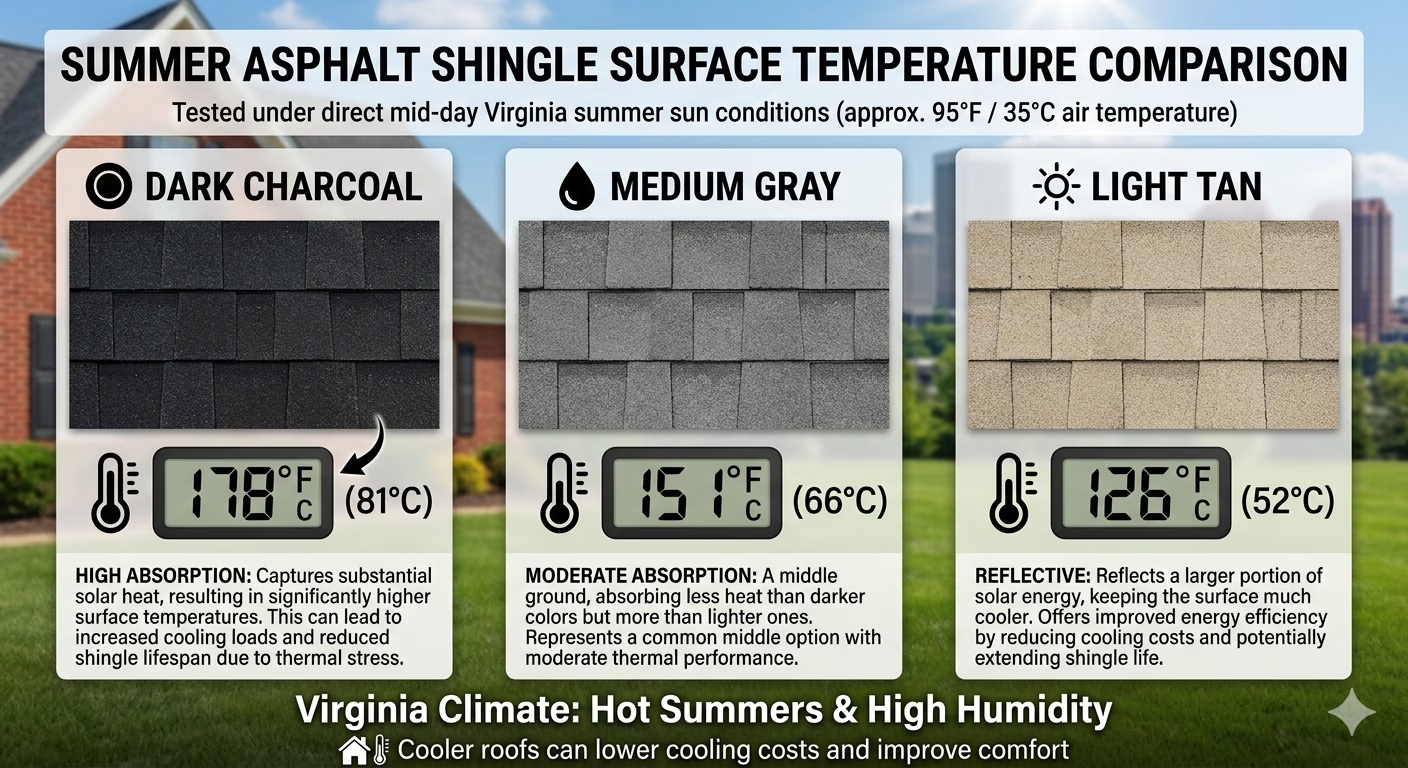
Can a New Roof Lower Your Virginia Energy Bills? What to Expect by Material and Season
Oct. 21, 2026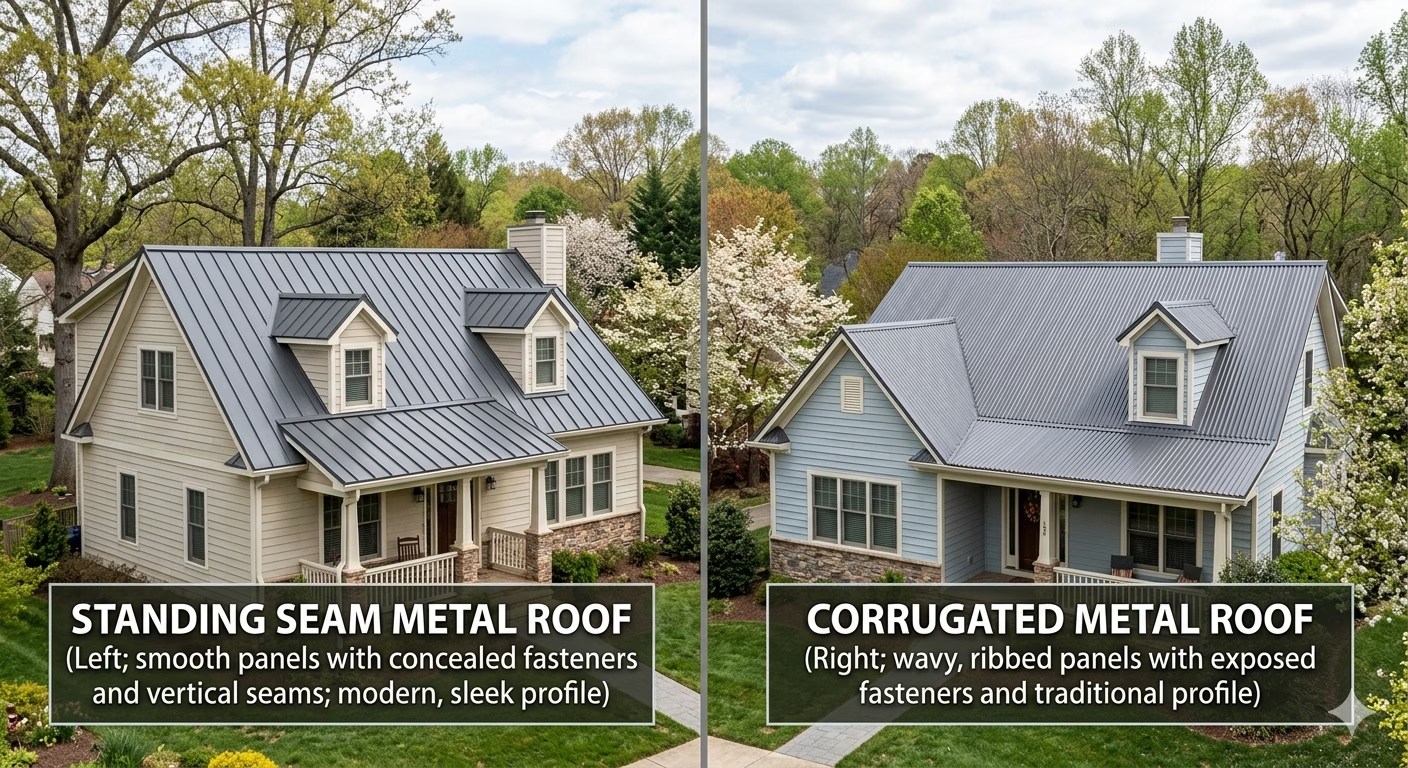
Metal Roofing Cost in Virginia: Standing Seam vs Corrugated and What’s Actually Worth It for Your Home
Oct. 09, 2026Topics
Our Services
- Gutter Services
- Storm Damage Roofing
- Commercial Roofing Service
- BRAVA Cedar Shake Roofing Tile
- Insurance Claim Assistance
- Residential Roofing Services
- Roof Inspection Services
- Roof Repair Service
- Roof Replacement Service
- Shingle Roofing Service
- Metal Roofing Service
- Emergency Roof Repair Services
- BRAVA Spanish Tile
- BRAVA Slate Tile