Contact Us Today
Uncategorized
Choosing a Roofing Contractor in Virginia: 6 Essential Questions
The Problem With Picking a Roofer From a List
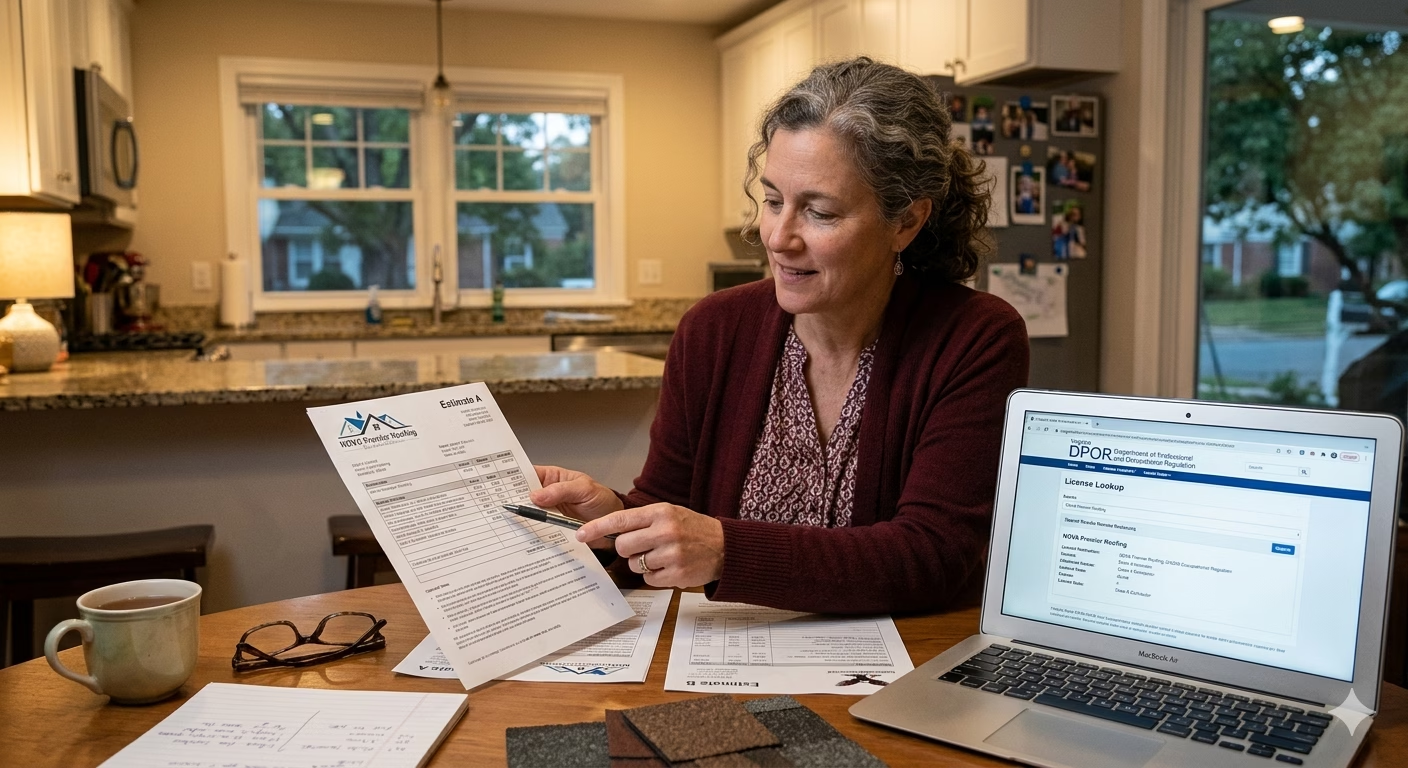
When a homeowner’s roof reaches end-of-life or takes storm damage, the immediate instinct is to find a contractor as quickly as possible. A Google search for “roofing contractor near me” returns dozens of results. Google reviews exist for most of them. Websites look professional. The problem is that the tools most homeowners use to evaluate contractors Google search results, website quality, and review counts do not reliably distinguish between a legitimate professional who will stand behind their work for years and an operator who will be unreachable when problems arise.
Roofing has specific characteristics that make it higher-risk than most home improvement categories:
- The work is done out of the homeowner’s sight. A homeowner cannot see whether the ice and water shield was installed correctly, whether the attic ventilation modifications were actually made, or whether the decking that was identified as rotted was actually replaced. They see the finished surface. Everything below it is trust.
- The cost is significant. A residential roof replacement in Central Virginia typically runs $8,000 to $30,000 or more. This amount creates both a significant incentive for corners to be cut and a significant loss when problems emerge years later.
- Problems often take years to manifest. A badly installed roof may look fine for two or three years before flashing failures, inadequate underlayment, or ventilation issues produce the water damage or premature deterioration that reveals the problem. By that point, a contractor who did not intend to stand behind their work may be unreachable.
The six questions below are designed to produce information that a website and reviews cannot give you. They can be asked in a five-minute conversation. The answers will tell you more about whether a contractor is worth trusting than any marketing material they have produced.
Question 1: Can You Provide Proof of Virginia Contractor Licensing?
This is the baseline question, and it should be asked first.
What Virginia Law Requires
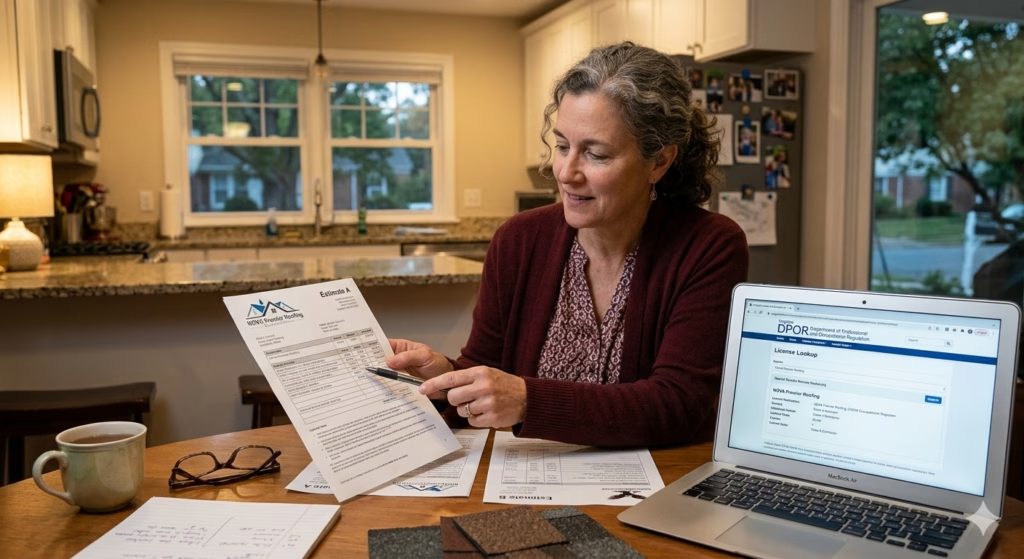
Virginia requires that any contractor performing roofing work with a total project value above $1,000 hold a valid Class A, B, or C contractor license from the Virginia Department of Professional and Occupational Regulation (DPOR). The license classification determines the scope of work and contract size the contractor is authorized to take on:
- Class C: Single-trade contractors with projects up to $10,000 per project and $150,000 annually
- Class B: Multi-trade or larger single-trade contractors with projects up to $120,000 and $750,000 annually
- Class A: No project or annual limits; the highest classification
A full residential roof replacement at typical Central Virginia prices almost certainly exceeds $10,000, meaning a Class C license is inadequate for most residential roofing projects. The contractor performing your work should hold a Class B or Class A license.
How to Verify
Do not rely solely on what the contractor tells you. Verify independently using the DPOR’s online license lookup tool at dpor.virginia.gov. Enter the company name or license number, and the database will show whether the license is current, in what classification, and whether any disciplinary actions have been taken.
This two-minute verification is one of the most protective steps a Virginia homeowner can take before entering any roofing contract.
What an Unlicensed Contractor Costs You
Beyond the legal exposure of contracting with an unlicensed operator, the practical consequence is exclusion from Virginia’s Contractor Transaction Recovery Fund. This fund exists to compensate homeowners who suffer financial loss from a licensed contractor’s fraudulent, deceptive, or dishonest acts. If the contractor is unlicensed, the fund is unavailable regardless of the loss.
A legitimate Virginia roofing contractor provides their license number readily and without resistance. It should appear on their written estimate and contract.
Question 2: What Is Your Current Insurance Coverage, and Will You Provide a Certificate?
Insurance protects you from financial liability when something goes wrong during the project. A contractor without adequate insurance means that if a crew member is injured on your property, or if equipment damages your home, the resulting claims come back to you rather than being handled by the contractor’s coverage.
What Coverage Matters
General liability insurance: Covers property damage caused by the contractor’s operations. If a crew member drops equipment through a skylight, clips a fence post with the dumpster truck, or causes other property damage, the general liability policy is what pays. For a residential roofing project, $1 million in general liability coverage is an appropriate minimum.
Workers’ compensation insurance: Covers medical costs and lost wages for crew members injured on the job. In Virginia, contractors with three or more employees are required to carry workers’ compensation. If a crew member falls from your roof and the contractor does not carry workers’ compensation, the injured worker may have grounds to make a claim against your homeowner’s insurance, or potentially against you directly.
How to Verify
Ask specifically for a certificate of insurance, not just confirmation that they are insured. A certificate is a document issued by the contractor’s insurance agent that confirms the coverage types, amounts, and policy expiration dates. A contractor who is actually insured can produce this within a business day at most.
Confirm that the certificate lists your property address as the job site for the period of the project, which is standard practice for project-specific insurance verification.
The Red Flag to Watch For
A contractor who says they are insured but resists or delays producing a certificate is either not actually insured or has coverage that does not meet an appropriate threshold. Neither situation is acceptable. Move on.
Question 3: How Long Have You Been Operating in This Area, and Can You Provide Local References?
This question evaluates the thing that most differentiates a legitimate local contractor from a storm chaser, a new operation without a track record, or a company whose business model does not depend on local reputation.
Why Local Longevity Matters
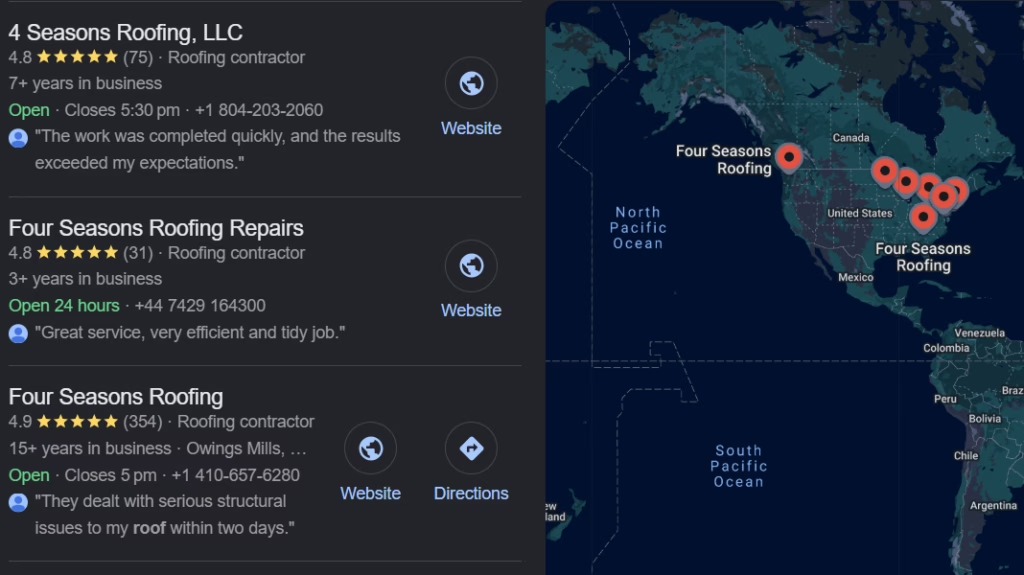
A roofing contractor who has been operating in the same community for five, ten, or fifteen years has built their business on repeat customers and referrals from those customers. They have a track record that can be verified through reviews across multiple platforms, references from past customers who will speak honestly about their experience, and a physical presence that cannot simply disappear when problems arise.
A contractor who arrived after a storm event, whose business address is in another state, or who has been operating locally for less than two years cannot offer the same accountability. Their incentive structure is fundamentally different: completing transactions rather than building a reputation for long-term relationships.
What to Ask About References
Ask specifically for references from projects similar to yours in scope and in your general geographic area. A reference from a roof replacement in Charlottesville or Lynchburg is more meaningful than one from a project in another state. Ask the references:
- Was the crew professional and respectful of the property?
- Was the project completed on schedule?
- Was the post-project cleanup thorough?
- Have you had any issues since the project was completed, and if so, how were they handled?
That last question is the most revealing. Problems arise on some percentage of roofing projects despite best efforts. How a contractor handles problems after the project is more predictive of your experience than whether problems occurred.
Online Reviews as Supporting Evidence
Online reviews are useful supplemental evidence. Look for volume over time (a contractor with 50 reviews accumulated over five years is more credible than one with 50 reviews from the last three months), consistency across platforms (Google, HomeAdvisor, Better Business Bureau), and specific detail in positive reviews (customers who describe specific crew members, specific situations, or specific quality observations are more credible than generic praise).
Pay particular attention to how the contractor responds to negative reviews. A defensive or dismissive response to a critical review is more revealing than the negative review itself. A professional response that acknowledges the concern and explains how it was or would be addressed communicates the same character that will show up when the situation is your project and your concern.
Question 4: What Specific Manufacturer Warranty Does the Material Carry, and What Does Your Workmanship Warranty Cover?
This question unpacks an area where significant confusion exists among homeowners and where the confusion is sometimes exploited.
The Two Separate Warranties That Matter
Manufacturer warranty: The shingle manufacturer (GAF, Owens Corning, CertainTeed, Atlas, and others) provides a warranty on their product covering manufacturing defects and, depending on the warranty tier, wind resistance and algae resistance performance. Manufacturer warranties range from basic 25-year limited coverage to enhanced lifetime warranties that also include installation workmanship under certain conditions.
Contractor workmanship warranty: The installing contractor provides a separate warranty on the quality of their installation. This warranty covers problems that result from how the roof was installed, not from defects in the materials themselves. Flashing failure at a chimney that was improperly installed, for example, would be a workmanship warranty claim rather than a manufacturer warranty claim.
What to Verify About Each
For the manufacturer warranty:
- What is the specific product and warranty tier being installed?
- Does the warranty require installation by a certified contractor (some enhanced warranty tiers do)?
- What does the warranty actually cover (many homeowners assume manufacturer warranties are more comprehensive than they are)?
For the workmanship warranty:
- How long is the workmanship warranty in effect?
- What specifically does it cover?
- Is it in writing?
- Is the warranty transferable to a future owner if the home is sold?
A contractor who offers only a vague verbal statement about standing behind their work is offering something that is very difficult to enforce. A contractor who provides a specific written workmanship warranty with defined terms is making a commitments that can be held accountable.
The Red Flag to Watch For
A contractor who emphasizes only the manufacturer warranty and does not offer a clear, written workmanship warranty may be hoping you will assume the manufacturer warranty covers installation problems. It typically does not. Make sure both warranties are explicitly addressed and documented.
Question 5: Will You Handle All Aspects of the Project With Your Own Crew, or Will Work Be Subcontracted?
Subcontracting is common in the construction industry and is not inherently problematic. But the way it is used or not disclosed by different contractors creates meaningful differences in quality control and accountability.
The Subcontracting Continuum
Fully integrated crew: All work on the project is performed by the contractor’s own employees, supervised by the same team that sold the project and holds the license. Quality control is direct and personal. If a problem arises during or after the project, the same people who did the work address it.
Disclosed subcontracting: The primary contractor uses subcontractors for specific portions of the work (sheet metal flashing fabrication, for example) but is transparent about this, and the subcontractors are qualified and carry their own appropriate insurance. The primary contractor retains responsibility for the total project quality and serves as the point of accountability.
Undisclosed or volume subcontracting: The primary contractor is primarily a sales organization. Once a contract is signed, the project is handed to a subcontract crew that may rotate between multiple markets, may have limited familiarity with the primary contractor’s quality standards, and over whose work the primary contractor exercises limited direct oversight. This model produces the widest variance in quality outcomes.
Why This Matters for Your Project
When a problem arises after installation, the accountability for resolving it runs through the contractor named on your contract. If that contractor has subcontracted the work and has limited insight into what was actually done during installation, the path to resolution becomes more complicated.
What to ask directly:
- Will the crew that installs my roof be your employees, or will the project be subcontracted?
- If subcontracted, who specifically will be on the project, and can you provide their licensing and insurance information?
- Who from your organization will be on-site during the installation to supervise the work?
A contractor who is present during installation, or whose employees are performing the work, is a contractor who is directly accountable for the quality of what happens on your roof.
Question 6: What Does the Written Contract Specify, and What Is Your Process If Something Unexpected Arises During the Project?
The contract is the document that governs what happens when something does not go according to plan. A detailed, specific contract protects both parties. A vague or incomplete contract typically protects the contractor at the homeowner’s expense.
What a Complete Contract Should Specify
Scope of work: Every component of the project should be listed: tear-off layers being removed, specific shingle product and color, underlayment type, ice and water shield specification and coverage area, flashing specifications, ventilation modifications, drip edge, and any agreed-upon decking replacement provisions.
Material specifications: The brand, product line, and specific SKU of the shingle product. Not “architectural shingles” the specific manufacturer and product name.
Timeline: Start date (or window), estimated project duration, and any conditions that could affect the timeline (weather, material availability).
Pricing: Total contract price, payment schedule, and specific provisions for any potential additional costs (decking replacement rate per square foot, for example).
Warranty terms: Both the manufacturer warranty documentation and the contractor’s written workmanship warranty should be referenced or attached.
Change order process: How changes to the original scope are handled, documented, and priced. Verbal agreements during a project are unenforceable. All changes should be documented in writing.
License and insurance confirmation: The contractor’s license number and insurance confirmation should appear on the contract document.
What to Ask About Unexpected Discoveries
Unexpected conditions during a roof replacement rotted decking beneath the tear-off, inadequate framing, pest damage, or structural issues are not rare. They are a normal possibility in any roof replacement on a home of any age.
Ask specifically:
- If you discover additional decking damage during the tear-off beyond what was estimated, what is the process?
- Will you show me the specific area of concern before proceeding with any work beyond the original scope?
- What is your per-square-foot rate for any additional decking replacement?
A professional contractor has a clear, transparent process for these situations: showing the homeowner the issue, confirming the additional cost in writing before proceeding, and obtaining approval before any additional work is performed. A contractor who simply proceeds with additional scope without homeowner approval and adds it to the final invoice is a contractor operating without appropriate transparency.
A Note on Post-Storm Solicitations in Virginia
Every significant hail event, windstorm, or tropical storm remnant that affects Central Virginia is followed within days by out-of-state contractors driving through neighborhoods and knocking on doors. These solicitations require specific awareness because the tactics used are designed to bypass the evaluation process described in this post.
What Post-Storm Solicitors Do
They create urgency. “We’re already in the neighborhood, we can start this week, but we’re almost booked.” The urgency is manufactured: a legitimate local contractor will schedule your project when it fits properly in their queue, not under artificial time pressure.
They make insurance promises. “We’ll work with your insurance company, you won’t pay a thing.” As covered in our insurance claim guide, your deductible is your contractual obligation and cannot legally be waived by a Virginia contractor. A contractor who promises to make your deductible disappear is either misrepresenting the situation or proposing an arrangement that could create legal exposure for you.
They pressure for immediate commitment. A legitimate roofing contractor will give you time to review a written estimate, verify their credentials, and make an informed decision. Any contractor who requires a same-day or next-day signature is operating in a way that benefits only them.
What to Do Instead
If your home has been affected by a storm event:
- Document the damage with photographs before anyone touches anything
- Contact a contractor with a verified local track record for a professional damage assessment
- Open your insurance claim after consulting with the contractor about the scope of documented damage
- Do not sign anything with a contractor you cannot verify through the DPOR license database and local reviews
For professional storm damage assessment in the Central Virginia area, Four Seasons Roofing provides inspection and insurance claim assistance as a standard service, not as a mechanism for capturing business under pressure.
Putting the Six Questions Together
The questions in this post are not designed to be confrontational. They are designed to be direct. A contractor who answers all six without hesitation, who provides documentation willingly, and who demonstrates through their answers that they operate with transparency and accountability is a contractor worth trusting with a significant project on your home.
Use this as a quick reference before any contractor conversation:
- License verification: “Can you provide your Virginia DPOR contractor license number so I can verify it?”
- Insurance: “Can you provide a certificate of insurance showing general liability and workers’ compensation coverage?”
- Track record: “How long have you been operating in this area, and can you provide three references from projects similar to mine in the last two years?”
- Warranty: “What specific manufacturer warranty does this product carry, and what does your written workmanship warranty cover and for how long?”
- Crew: “Will the crew on my project be your employees, and who from your organization will be on-site to supervise?”
- Contract: “Does your written contract specify the complete scope of work and materials by product name, and what is your process if unexpected conditions are discovered during installation?”
These six questions, answered honestly and in writing where appropriate, give you the foundation for a decision based on substance rather than marketing.
How Four Seasons Roofing Answers These Questions
The most credible answer to any contractor evaluation question is one that can be independently verified. For those evaluating Four Seasons Roofing for a Central Virginia project:
License: Four Seasons Roofing holds a valid Virginia Class A contractor license, verifiable through the DPOR database.
Insurance: Full general liability and workers’ compensation insurance, with certificates available upon request.
Track record: Operating in Central Virginia since 2010, with verifiable reviews on Google, the Better Business Bureau, and other platforms spanning more than a decade.
Warranty: Our projects specify the manufacturer warranty for the installed product and include a written workmanship warranty with specific terms.
Crew: Projects are performed by our own team. The owners are involved in project oversight.
Contract: Our written contracts specify complete scope, material specifications by product name, pricing, timeline, and warranty documentation.
A free roof inspection is the starting point for any Central Virginia homeowner who wants to evaluate our work firsthand and ask these questions directly. Call 434-390-0199 or schedule online.
The Bottom Line
Choosing a roofing contractor in Virginia does not have to be a guessing process. The six questions in this post produce verifiable, specific information that distinguishes legitimate professionals from operators whose model depends on the homeowner not asking the right questions.
A roof replacement is a significant investment in a structure that protects everything inside your home. It deserves the same evaluation process you would apply to any major decision: verify the credentials, ask the hard questions, read the contract before signing, and make the decision based on substance rather than price or persuasion.
The contractor who earns your business by answering these six questions clearly is the contractor most likely to still be there, with a reputation worth protecting, when you need something addressed three years from now.
Why Schedule a Call?
Popular Insights
Can a New Roof Lower Your Virginia Energy Bills? What to Expect by Material and Season
Oct. 21, 2026
Metal Roofing Cost in Virginia: Standing Seam vs Corrugated and What’s Actually Worth It for Your Home
Oct. 09, 2026How to Choose a Roofing Contractor in Virginia: 6 Questions That Separate Professionals from Fly-by-Nights
Oct. 02, 2026
New Roof Installation in Lynchburg, VA: What Homeowners Can Expect from Estimate to Final Day
Sep. 25, 2026
Storm Damage Roofing in Central Virginia: What to Do in the First 24 Hours After Your Roof Is Hit
Sep. 23, 2026Topics
Our Services
- Gutter Services
- Storm Damage Roofing
- Commercial Roofing Service
- BRAVA Cedar Shake Roofing Tile
- Insurance Claim Assistance
- Residential Roofing Services
- Roof Inspection Services
- Roof Repair Service
- Roof Replacement Service
- Shingle Roofing Service
- Metal Roofing Service
- Emergency Roof Repair Services
- BRAVA Spanish Tile
- BRAVA Slate Tile