Contact Us Today
Uncategorized
Can a New Roof Lower Your Virginia Energy Bills? What to Expect by Material and Season
October 21, 2026
Key Takeaways
- Your roof is responsible for a significant share of your home’s heat gain in summer and heat loss in winter, making it a direct driver of your energy costs year-round.
- Metal roofing with a reflective finish offers the strongest summer energy savings in Virginia, reducing cooling loads by 10 to 25% in many cases.
- Architectural shingles with a cool-roof rated granule surface provide a budget-friendly middle ground with modest but real efficiency gains.
- BRAVA composite roofing (cedar shake, slate, and Spanish tile profiles) delivers excellent thermal mass properties that help moderate temperature swings across seasons.
- Energy savings from a new roof are not automatic. Proper attic ventilation, insulation depth, and installation quality determine whether your new roof performs to its potential.
- Virginia’s four distinct seasons create a dual-threat energy environment: you need a roof that manages both summer heat gain and winter heat retention.
- A professional roof inspection is the fastest way to know whether your current roof is undermining your home’s energy performance right now.
The Question Most Virginia Homeowners Do Not Think to Ask
When a roof starts to fail, homeowners focus on the obvious: stopping leaks, preventing water damage, and protecting their home. Energy bills rarely enter the conversation.
That is a missed opportunity.
Your roof is the single largest surface of your home exposed to the elements. In Virginia’s climate, where summers push heat indexes into triple digits and winters demand serious heating output, a poorly performing roof is quietly adding dollars to your utility bills every month.
The good news: a new roof, chosen and installed correctly, is one of the most impactful thermal upgrades you can make to a house. The important caveat is that the material choice matters enormously, and the season-specific benefits vary more than most homeowners expect.
This guide breaks it all down in plain language.
Why Your Roof Drives Energy Costs in Virginia’s Climate
Virginia sits in IECC Climate Zone 4, which means it qualifies as a mixed-humid climate. That is the engineering shorthand for a region that demands both strong cooling performance in summer and meaningful heating performance in winter.
Here is what that means for your roof specifically:
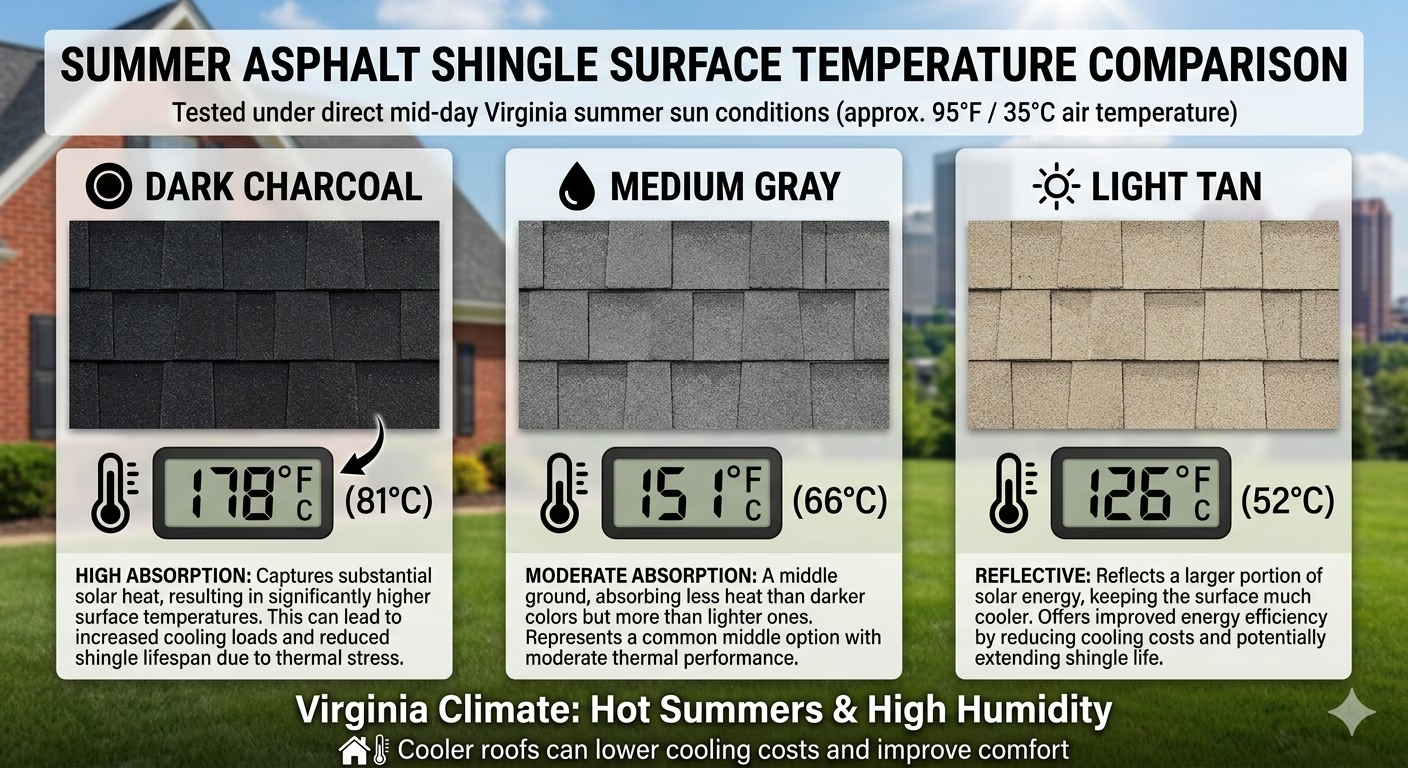
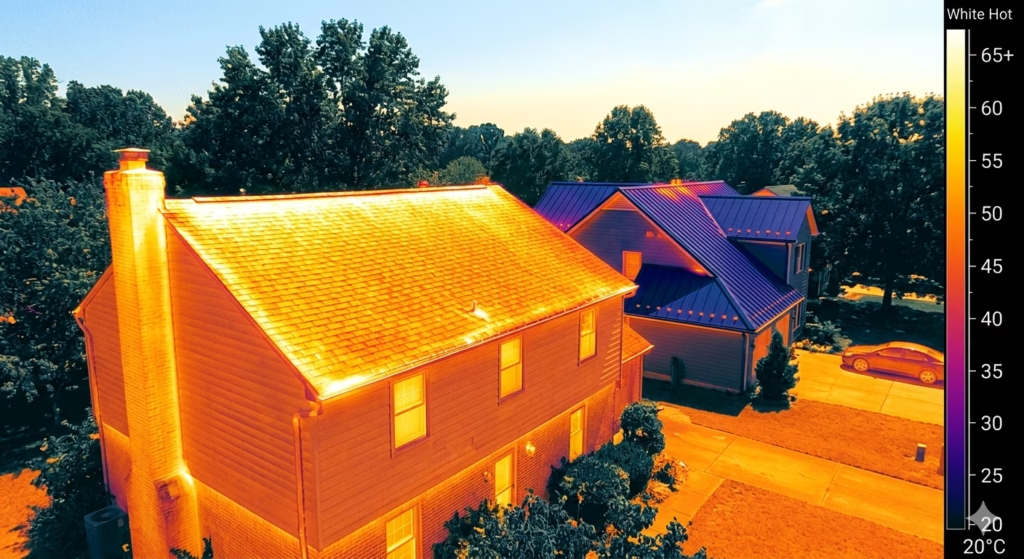
Summer (June through September): Solar radiation hits your roof for 8 to 12 hours a day. A dark asphalt shingle surface can reach temperatures of 150 to 190 degrees Fahrenheit on a 90-degree day. That heat radiates into your attic space, which then transfers into your living area. Your air conditioning system works harder and runs longer to compensate.
Winter (December through February): Heat moves from warm spaces to cold ones. A poorly insulated or ventilated attic allows conditioned air from your living space to escape upward and out through the roof assembly. Your heating system continuously replaces that lost warmth.
Spring and Fall: Temperature swings in Virginia can be dramatic, sometimes 30 to 40 degrees within a single day. Roofing materials with poor thermal stability allow these swings to stress the building envelope, contributing to drafts and uneven indoor temperatures.
An aging roof compounds all of these problems. Cracked, curled, or thin shingles allow air infiltration. Degraded underlayment reduces the thermal buffer. Failing ventilation components turn the attic into an oven in summer and a cold trap in winter.
The key insight: Replacing an aging roof does not just stop leaks. It resets the entire thermal performance of your home’s most exposed surface.
Roofing Material and Energy Performance: A Honest Comparison for Virginia Homes
Not all roofing materials perform the same way. Here is a frank breakdown of the most common options available to Virginia homeowners.
Architectural Asphalt Shingles
Architectural shingles remain the most common residential roofing material in Virginia, and for good reason. They are accessible, cost-effective, and have improved significantly in the past decade.
Energy profile: Standard dark architectural shingles absorb a high proportion of solar radiation. However, many manufacturers now offer shingles with “cool roof” certified granule coatings that reflect more of the solar spectrum. These carry an Energy Star rating and can reduce roof surface temperatures by 20 to 30 degrees Fahrenheit compared to standard dark shingles.
Summer performance: Moderate. Cool-roof certified shingles deliver real savings, but they still absorb more heat than metal. Lighter colors (tan, light gray, weathered wood) meaningfully outperform darker options (charcoal, dark brown) in Virginia’s summer heat.
Winter performance: Good. Asphalt shingles provide a decent thermal layer, and the granule surface helps retain some heat in the roof assembly. The bigger winter factor is underlayment quality and attic insulation, not the shingle itself.
Realistic Virginia energy savings vs. aging roof: 5 to 15% reduction in cooling costs during summer months, depending on color selection and attic conditions.
Metal Roofing (Standing Seam and Corrugated)
Metal roofing is where the energy efficiency conversation gets genuinely compelling for Virginia homeowners.
Energy profile: Bare metal reflects solar radiation well, but the real performance driver is the paint finish. Metal roofs with Kynar 500 PVDF paint systems and “cool roof” certified reflective pigments can reflect 65 to 80% of solar energy, versus 5 to 25% for a dark asphalt shingle. That is a dramatic difference in summer heat gain.
Summer performance: Excellent. Reflective metal roofing keeps attic temperatures significantly lower than asphalt alternatives. Studies conducted in warm-humid climates comparable to Virginia have shown cooling energy reductions of 10 to 25% in homes with reflective metal roofs and proper attic ventilation.
Winter performance: This is the nuance most articles skip. Metal itself does not insulate. The thermal benefit in winter comes from the air gap created between the metal panel and the roof deck, combined with the quality underlayment beneath. In Virginia’s winters, a properly installed metal roof with a continuous ventilation channel performs comparably to high-quality shingles. The key is proper installation, not the metal itself.
Emissivity matters: A metal roof with high emissivity (the ability to release absorbed heat quickly) cools down faster after sunset than asphalt, which continues radiating stored heat into the attic for hours. In Virginia’s humid summers, this after-sunset cooling effect is a real and meaningful benefit.
Realistic Virginia energy savings vs. aging roof: 10 to 25% reduction in summer cooling costs with a reflective finish. Winter savings are modest but present, primarily through reduced air infiltration.
Virginia-specific note: Dominion Energy Virginia customers may be eligible for energy efficiency rebates when upgrading to certified cool roof products. Check current program availability, as rebates change year to year.
BRAVA Composite Roofing (Cedar Shake, Slate, and Spanish Tile Profiles)
BRAVA composite roofing tiles are a premium option that combines the aesthetic of traditional roofing materials with modern manufacturing. Four Seasons Roofing installs all three BRAVA profiles, including BRAVA Cedar Shake, BRAVA Slate, and BRAVA Spanish Tile.
Energy profile: BRAVA tiles are manufactured from a proprietary polymer composite that provides significantly higher thermal mass than asphalt shingles. Higher thermal mass means the material resists rapid temperature changes, absorbing heat slowly and releasing it slowly.
Summer performance: Good to excellent. The thicker tile profile creates natural air channels that reduce direct heat transfer to the deck. Combined with lighter color options, BRAVA composite performs well in Virginia’s summer heat without the installation complexity of metal.
Winter performance: Strong. Thermal mass is particularly beneficial in Virginia’s shoulder seasons (spring and fall) and mild winters. The tile profile holds warmth longer than thin asphalt, helping to moderate the temperature swings that are common in Central Virginia from October through April.
Additional benefit: BRAVA composite is Class 4 impact-rated, which may qualify Virginia homeowners for insurance discounts, effectively reducing the true cost of ownership.
Realistic Virginia energy savings vs. aging roof: 8 to 18% reduction in cooling costs; moderate winter performance improvement driven primarily by reduced air infiltration and improved thermal stability.
Season-by-Season Energy Impact: What Virginia Homeowners Actually Experience
Let’s make this practical and Virginia-specific.
Summer (June through September): The Biggest Opportunity
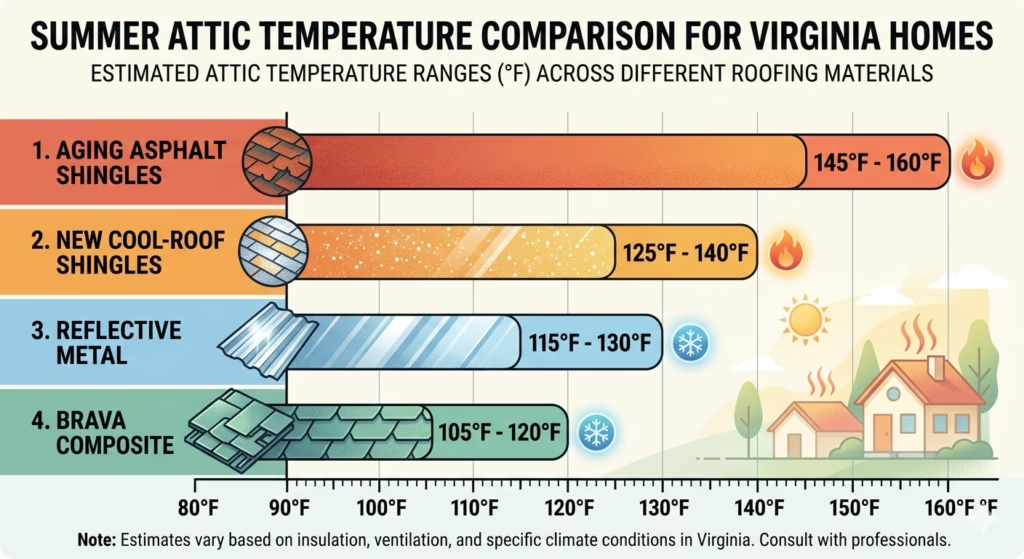
This is where a new roof pays off fastest in Virginia. The combination of high humidity and intense solar radiation creates prolonged attic heat stress. An aging, dark shingle roof with poor ventilation can push attic temperatures to 140 to 160 degrees Fahrenheit.
A new reflective metal or cool-roof certified shingle roof, paired with proper ridge and soffit ventilation, can bring that same attic down to 95 to 110 degrees Fahrenheit under the same outdoor conditions.
For a 2,000 square foot Central Virginia home running central air conditioning, that difference can translate to $50 to $150 per month in reduced cooling costs during peak summer months.
What amplifies summer savings:
- Lighter roof color selection
- Proper ridge vent and soffit vent installation (allowing hot attic air to escape naturally)
- R-38 or higher attic insulation (separates the hot attic from the conditioned living space)
- Radiant barrier installation on the underside of the roof deck
Fall (October through November): The Transition Window
Virginia falls are variable. Warm days and cool nights put stress on your home’s thermal envelope. A new roof reduces air infiltration significantly, which matters when outdoor temperatures are swinging dramatically.
Expect modest but consistent savings as your HVAC system switches between heating and cooling less frequently when the thermal envelope is tighter.
Winter (December through February): The Hidden Loss Point
Heat loss through the roof assembly is the primary winter energy concern. In older homes with degraded roofing and inadequate attic insulation, 25% or more of heating energy can escape through the ceiling and roof assembly.
A new roof tackles this in two ways:
- Reduced air infiltration: New decking, underlayment, and shingles eliminate the gaps, cracks, and failed seals that allow conditioned air to escape.
- Proper ventilation reset: Counter-intuitively, proper attic ventilation in winter keeps the attic cold and dry, which prevents ice dams and protects the roof structure. Ice dams are a real concern in Virginia’s Blue Ridge and mountain regions.
What amplifies winter savings:
- High-quality synthetic underlayment (significantly better than felt paper at reducing air movement)
- Proper flashing at all penetrations and transitions
- Ridge vent and baffled soffit vents to maintain consistent attic airflow
- Attic insulation upgrade performed alongside the reroof
Spring (March through May): The Payback Season
Spring in Virginia can mean 50-degree mornings and 80-degree afternoons in the same week. A well-performing new roof with good thermal stability reduces the HVAC cycling that drives energy costs during this unpredictable period.
This is also when the cumulative benefit of reduced air infiltration becomes most apparent. Homeowners with new roofs often notice more even temperatures throughout the home during spring, particularly in rooms that previously felt drafty or inconsistently heated.
The Variables That Determine Whether You Actually See Savings
A new roof alone does not guarantee lower energy bills. These are the factors that determine whether the efficiency gains translate to real dollar savings.
Attic Ventilation
This is the single most overlooked factor. A reflective metal or cool-roof shingle cannot perform to its potential if hot air is trapped in the attic with no path to escape.
A properly functioning system requires:
- Soffit vents at the eave (intake)
- Ridge vents at the peak (exhaust)
- Clear baffles between the insulation and the roof deck to maintain an unobstructed airflow channel
Many older Virginia homes have inadequate or partially blocked ventilation. A professional roof inspection will identify ventilation problems that are silently limiting your home’s energy performance right now.
Attic Insulation Depth
The Department of Energy recommends R-49 to R-60 attic insulation for Virginia’s Climate Zone 4. Many homes, especially those built before 2000, have R-19 to R-30.
Replacing your roof without addressing inadequate insulation leaves significant energy savings on the table. The two upgrades are most powerful when done together.
Underlayment Quality
Synthetic underlayments have dramatically outpaced traditional felt paper in both air-sealing and moisture performance. For energy efficiency, the underlayment layer matters more than most homeowners realize, because it is the critical barrier between the exterior and the attic space.
Installation Quality
A reflective metal roof with improperly installed flashing, gaps at the ridge, or incorrectly sized ventilation openings will underperform its rated specifications. Material choice matters, but installer experience matters equally. This is not a category to compromise on.
Real Numbers: What to Realistically Expect on Your Virginia Energy Bill
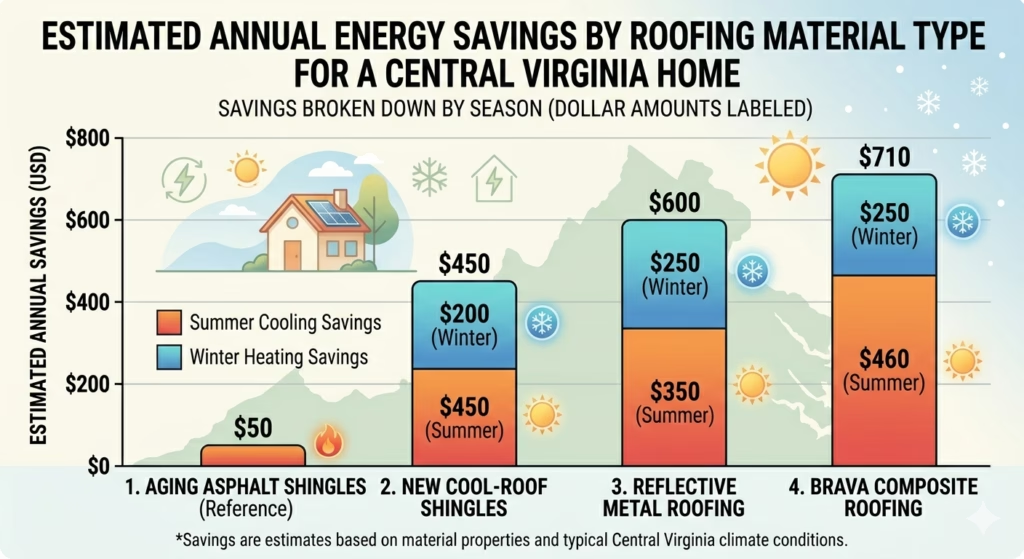
These are estimates for a 1,800 to 2,200 square foot Central Virginia home replacing an aging (15+ year) dark asphalt shingle roof, assuming proper attic ventilation and R-38+ insulation.
| New Roof Material | Est. Summer Cooling Savings | Est. Winter Heating Savings | Est. Annual Total Savings |
|---|---|---|---|
| Standard new asphalt shingles (dark color) | 3 to 8% | 3 to 7% | $120 to $350/yr |
| Cool-roof certified shingles (light color) | 8 to 15% | 4 to 8% | $200 to $500/yr |
| Reflective metal roofing | 12 to 25% | 5 to 10% | $300 to $750/yr |
| BRAVA composite tiles | 8 to 18% | 5 to 10% | $225 to $550/yr |
Important context: These figures assume the old roof was degraded and air-leaking. The savings are relative to the aging baseline, not to a relatively new but standard shingle roof. Homeowners replacing a 5-year-old shingle roof with metal will see smaller percentage improvements.
Frequently Asked Questions
Will a new roof alone pay for itself through energy savings?
Not in most cases, at least not primarily through energy savings alone. The payback calculation works best when you factor in avoided replacement costs, reduced maintenance, extended lifespan, potential insurance premium reductions, and increased home resale value alongside energy savings.
Does roof color matter as much as material?
For asphalt shingles, color is one of the biggest levers you can pull. A light gray or tan shingle can outperform a dark charcoal shingle by 10 to 15 degrees Fahrenheit in surface temperature. For metal roofing, the paint system and reflectivity rating matter more than color alone.
My house has a dark roof. Should I replace it early for energy savings?
If your roof is 15+ years old and you are already thinking about replacement in the next few years, the answer is often yes, particularly if you switch to a more reflective material. Replacing a roof that is only 5 to 8 years old purely for energy savings rarely makes financial sense.
Does Virginia have any tax incentives for energy-efficient roofing?
Cool roof products that meet Energy Star certification may qualify for federal residential energy tax credits under current legislation. Consult a tax professional for guidance specific to your situation, as program details change.
The Starting Point: Know What You Are Working With
Before you can make an informed decision about roofing materials and energy performance, you need an honest assessment of your current roof’s condition.
An aging, failing roof may be leaking air, moisture, and conditioned energy in ways that are invisible from inside the house. The attic ventilation may be blocked. The decking may have soft spots that need addressing before any new material goes down.
The residential roofing team at Four Seasons Roofing serves Central Virginia homeowners with free roof inspections that assess not just the condition of your current roof, but the ventilation, flashing, and underlayment details that determine whether a new roof will actually perform to its energy-saving potential.
With over 14 years of experience and a 5.0 Google rating from Central Virginia homeowners, Four Seasons Roofing approaches every project with the same care and craftsmanship they would give their own home.
Final Verdict: Yes, a New Roof Can Lower Your Virginia Energy Bills
But the honest answer is: it depends on what you replace it with, how it is installed, and what other components of your attic system are addressed at the same time.
Here is the practical summary:
- If you want maximum summer savings: Go with a reflective metal roof in a light to medium color with a Kynar 500 paint system, paired with proper ridge and soffit ventilation.
- If you want a strong balance of savings and upfront cost: Choose cool-roof certified architectural shingles in a light color, and prioritize a synthetic underlayment upgrade.
- If you want aesthetics with strong thermal performance: BRAVA composite delivers excellent thermal stability and Class 4 impact resistance, with long-term energy benefits that compound over time.
- Whatever material you choose: Invest in your attic ventilation and insulation at the same time. The roof and attic system work together. Upgrading one without addressing the other leaves money on the table.
Your roof is not just a weather barrier. It is an active part of your home’s energy system. Treat it that way, and the investment pays dividends in every season.
Why Schedule a Call?
Popular Insights
Can a New Roof Lower Your Virginia Energy Bills? What to Expect by Material and Season
Oct. 21, 2026
Metal Roofing Cost in Virginia: Standing Seam vs Corrugated and What’s Actually Worth It for Your Home
Oct. 09, 2026
How to Choose a Roofing Contractor in Virginia: 6 Questions That Separate Professionals from Fly-by-Nights
Oct. 02, 2026
New Roof Installation in Lynchburg, VA: What Homeowners Can Expect from Estimate to Final Day
Sep. 25, 2026
Storm Damage Roofing in Central Virginia: What to Do in the First 24 Hours After Your Roof Is Hit
Sep. 23, 2026Topics
Our Services
- Gutter Services
- Storm Damage Roofing
- Commercial Roofing Service
- BRAVA Cedar Shake Roofing Tile
- Insurance Claim Assistance
- Residential Roofing Services
- Roof Inspection Services
- Roof Repair Service
- Roof Replacement Service
- Shingle Roofing Service
- Metal Roofing Service
- Emergency Roof Repair Services
- BRAVA Spanish Tile
- BRAVA Slate Tile